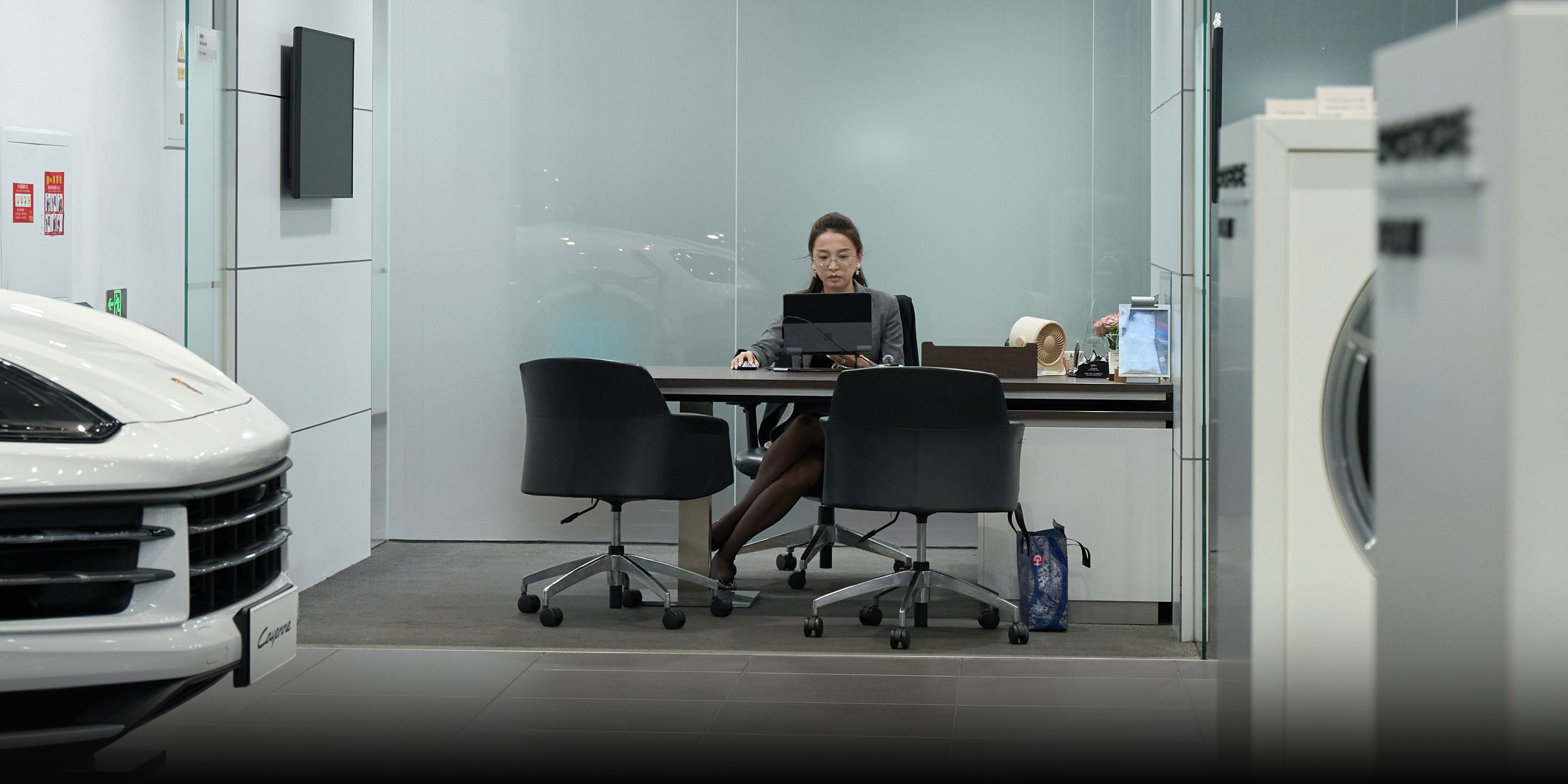
She Sold 192 Porsches in a Year. Then Came an AI-Fueled Smear Campaign.
Editor’s note: After Mu Qianwen hit the headlines in 2024 as one of Porsche’s top sales consultants worldwide, she became the target of toxic online abuse, including sexually explicit AI-generated videos. For this 35-year-old mother in Qingdao, in the eastern Shandong province, the harassment got so bad that she even contemplated suicide. Rather than give in, she decided to fight back through the courts. Here, Mu shares her ordeal in her own words.
I first started attracting attention online in early 2024. I’d already been “sales champion of the month” at my dealership more than 20 times, but on the last day of 2023, our sales manager presented me with a crystal trophy. I had sold 170 cars that year.
When I posted about the achievement on Xiaohongshu (the lifestyle platform known globally as RedNote), it soon became a trending topic, and more than a dozen media outlets asked me for interviews.
But there was also a huge backlash, with some questioning how I could have sold so many cars and suggesting that the dealership must have inflated my sales figures. Our general manager issued a statement to refute any talk of deception, but the allegations kept coming.
A woman selling luxury cars seems like an easy formula for a viral story. Some people claimed I was making 3 million yuan ($447,000) a year. Porsche pays its salespeople about 2,000 to 3,000 yuan in commission for every car sold. We can earn several hundred thousand yuan a year, but exceeding 1 million is extremely difficult. I make enough to give my family a comfortable life, and I do own an entry-level Porsche, but I’ve never made anything close to that amount.
Rumors also began circulating that I treat my customers to lavish dinners, which is pure innuendo. In reality, I work such long hours that I barely have time to eat, let alone entertain. I’ve never dated a customer or had any kind of inappropriate relationship. More than 60% of my buyers are women.
After people claimed that the dealership had exaggerated my sales figures, I set myself a goal: In 2024, I would sell another 170 cars, no matter what. On Dec. 31, I was still one car short of the target. But then a female customer walked in. I told her about my goal and offered her an attractive price on a model. It was win-win. A little after 3 p.m., she placed an order.
In 2025, I sold even more cars — 192. At this point, I felt I’d answered all my critics. But the online abuse had only gotten worse. Early that year, I discovered that someone had spread a sexually explicit rumor about me using an overseas social media platform. They claimed that I slept with customers, and posted as “proof” a fabricated video and audio recording using a different woman, whose face was concealed throughout.
I tried to brush it off and told myself not to take it too seriously, that this was just the price of publicity. But my friends urged me to report it to the police, so I ultimately filed a report.
At first, the explicit material mainly circulated on overseas websites and social media, so the impact was limited. But last October, things escalated. Someone shared a misleading video via (the instant-messaging platform) WeChat that combined one of my sales-promotion posters with footage of a woman with a completely different body shape to me undressing in a hotel room. There were also some demeaning AI-generated videos.
This time, the content spread incredibly fast among my circle. Friends, colleagues, and customers all started asking me what was going on. I felt like my world was collapsing. I again reported the videos to the police.
My phone number was also leaked, and I began receiving harassing calls, sometimes at one or two in the morning. A man in Qingdao called out of the blue to ask me to “come over and spend the night with him.” I recorded the conversation and sent it to the police, who issued the man a warning.
My WeChat was blowing up, too. I didn’t know whether a new friend request was from someone looking to buy a car or for something else. Some people would start by talking about cars and then steer the conversation toward asking me out. Others were more covert, asking me to record a video showing the “backseat legroom.” I knew what they really wanted. One person messaged, “I know it’s not you in those videos, but I fantasize that it is. Can you provide me with services?”
Social media is an important source of customers for me, so I couldn’t just ignore it. I still had to livestream. But when I was on camera introducing cars, I’d always see inappropriate comments pop up, like “I saw that video” or “You’re so hot.”
I even overheard some customers in the showroom talking about me. That hit me hard. I could no longer pretend that this online smear campaign wasn’t affecting me.
By now, the enthusiasm and confidence I used to have with customers was gone. I feared talking with people, paranoid that they must be gossiping about me.
At my lowest point, I briefly considered jumping from a building. I felt there was no point in being alive, that the world had become dark. It seemed everyone looked at me differently.
I told my supervisor that I had reached breaking point and needed time off. I was given three days, so I took my son back to my hometown, Yantai (about a three-hour drive from Qingdao), where we stayed at a beautiful guesthouse. I told myself that I had to keep living for my child and be responsible for my family. I had to clear my name.
When I returned to work, I was so anxious I couldn’t walk straight; my muscles were so tense I unconsciously leaned to one side. I wore a neck brace because even the slightest jolt during a test drive would send sharp pains up my back. I developed insomnia and tinnitus. At one point, I even struggled to speak.
Zero to hero
I started in auto sales in 2013, initially selling Audi and Lincoln cars in Beijing. I joined the Porsche dealership in downtown Qingdao in 2018. At first, my performance was so poor that I nearly lost my job.
Most of the salespeople had years of experience, and I was the youngest. Social media wasn’t the powerful tool it is today; business depended largely on walk-ins and referrals. For the first six months, I barely sold anything. At our 2019 New Year’s meeting, the sales manager asked everyone to share their goals for the year ahead. I said, “I want to survive at Porsche.”
I didn’t know the different models or specifications well enough. If a knowledgeable customer asked me a question, I felt intimidated and out of my depth. I started getting up at 6 a.m. to memorize technical information. I’d stand near colleagues and listen as they explained different cars. I studied the way they talked.
One colleague said I needed to dress better, so I started wearing tailored shirts and paying more attention to the cut and quality of everything I wore. In sales, it’s appearance, not skill, that makes the first impression. When I applied makeup, I felt more confident. Even though I had only four days off a month, I scheduled manicures and eyelash extensions, and sometimes skin booster injections.
I was a core consultant by my second year, became one of the dealership’s top performers in 2020, and was closing 17 deals a month in 2021.
Demand for foreign luxury cars has declined in the past two years, but my sales have continued to increase, largely because of social media. Of my 170 customers in 2023, 15% found me through social media. In 2025, it was 41%.
I also run a Porsche owners’ WeChat group with several hundred members. I organize monthly group events, such as camping trips, yacht outings, and nature walks. If I stop talking to someone as soon as a deal is done, they’ll always be just a customer. But if we spend time together, we can become friends. Referrals are an important part of my sales.
My typical workday runs from 8 a.m. to 8 p.m. I’ve hardly taken any annual leave in all these years. If I go on vacation, customers disappear. I’m competitive by nature. I crave deals, performance figures, the feeling of being number one. I’m currently leading Porsche’s global sales rankings for September 2026, but someone could still overtake me.
The hardest word
When selling cars, effort usually pays off. But clearing a damaged reputation? That’s different.
Someone can casually share something about me online, and suddenly I have to spend money, time, and energy to respond. I have to pay lawyers and gather evidence. I filed 31 complaints to Douyin (China’s version of TikTok) alone between October 2025 and April this year about abusive messages, videos that used my image without permission, and people cloning my voice to promote get-rich-quick books.
I hand the most egregious messages directly to the police. One man I reported was initially very cocky. He seemed to think I was bluffing and wouldn’t be able to track him down. The authorities eventually found him, and he sent me an apology.
A 20-something Porsche owner in Qingdao forwarded some offensive material about me in a group chat and was given five days of administrative detention. I later accepted his apology, too, but then his family called my dealership’s customer service line to complain — they couldn’t understand why he still needed to be detained. I had no say in his punishment, but they obviously never stopped to think about how his actions might have affected me.
Even the outcomes of such cases haven’t halted the spread of false allegations; I still encounter vitriol during livestreams and on social media.
In July this year, the police gave me details of a 30-something man in the eastern Fujian province who’d been behind one of the AI-generated videos. I’d never met him. He was given 10 days of administrative detention in last October, but he never contacted me to apologize.
I think receiving punishment is not the same as saying sorry. This man was punished for spreading rumors, but what about the harm he caused? So I decided to file a civil lawsuit against him. All I want is for him to apologize and say explicitly that the woman in that video is not me.
Some friends urged me to press criminal charges, but I don’t want him to bear the consequences for the rest of his life. As a mother, I think about what would happen to his child if he were prosecuted. My lawyer says that if the civil case goes to trial, it could take up to two years. No matter how long it takes, I need to see it through.
Now I’m facing claims that the lawsuit is a publicity stunt, that I’m dredging things up again. In reality, just because the story is no longer in the headlines, it doesn’t mean those negative voices have disappeared from my life.
My son is in kindergarten. He doesn’t have a phone, and he knows nothing about what’s going on. All he knows is that his mom is the top salesperson at Porsche Qingdao. When I asked him what he wanted to do when he grew up, he said he wanted to sell cars. He’s proud of his mom.
What happens when he grows up, gets a phone, and sees what people have said about his mother? What if his classmates use the rumors against him? Who takes responsibility for that? The same goes for my parents. I want to clear my name for my family’s sake.
I still like being number one, but after everything that’s happened, my ambition has waned. I want to focus more on family and my health.
My life used to be a straight line between work and home, but over the past two years, I’ve started leaving more time for myself — meals with colleagues and friends, live music bars, taking my son to the mountains or the beach.
I wonder whether the rumors will disappear once the lawsuit is over. If people keep talking, there might be nothing more I can do. I’ve done everything within my power. If I win the case, that will be the end of it for me.
Women have sent me long messages of support, telling me how brave I am. Many professional women have shared that they have been the targets of similar smear campaigns and felt completely helpless. They ask me what they should do. I don’t know what to tell them.
As told to reporter Jiang Wanru.
A version of this article originally appeared in White Night Workshop. It has been translated and edited for brevity and clarity, and is republished here with permission.
Translator: Carrie Davies; editors: Wang Juyi and Hao Qibao.
(Header image: Mu Qianwen at her workplace in Qingdao, Shandong province, August 2026. Jiang Wanru/White Night Workshop)